Cryptocurrency SEO Strategies: 13 Tactics to Rank Blockchain Websites

The global cryptocurrency market crossed a $3.5 trillion valuation in late 2024, and with it came an explosion in competition for organic search visibility. There are now more than 10,000 cryptocurrencies listed on CoinGecko alone, hundreds of new DeFi protocols launching every quarter, and NFT projects competing for the same slice of audience attention. Every single one of those projects has a website. Most of them want to rank on Google. Very few understand why they cannot.
Executing the right cryptocurrency SEO strategies is what separates the blockchain projects that dominate page one from the ones that have spent years publishing content and never cracked the top fifty. These are 13 blockchain SEO tactics built around how Google actually evaluates financial content, what cryptocurrency audiences are specifically searching for, and how to build the kind of organic authority that compounds month over month.
The challenge in this space is not a shortage of content. The internet is saturated with cryptocurrency articles, token explainers, and exchange comparison pages. The real problem is that most of it was written by people who understand blockchain but have never thought seriously about search intent, YMYL guidelines, topical authority, or technical rendering. That is precisely the gap these crypto SEO strategies are designed to close.
Boost Your Crypto SEO Now!!
Why Blockchain Websites Need a Different SEO Playbook
Standard SEO principles apply to blockchain websites, but they do not go far enough. Cryptocurrency falls squarely under Google’s Your Money or Your Life (YMYL) category, which means Google holds these pages to a significantly higher evidence standard than a recipe blog or travel guide.
A cryptocurrency website giving guidance on whether to invest in a token makes claims that can directly affect someone’s financial wellbeing. Google treats that seriously, and blockchain SEO must account for it from the outset. Beyond YMYL, cryptocurrency websites face unique pressures.
Paid advertising channels are largely restricted across Google Ads and Meta, which drives enormous competitive pressure onto organic search. Regulatory language shifts constantly across jurisdictions.
Token-related search terms have extremely volatile search volumes that spike and collapse with market cycles. A blockchain SEO strategy that does not account for all three of these variables will underperform, regardless of how well-executed it is technically.
Working with a dedicated crypto SEO agency that understands these nuances is the difference between building organic authority that compounds over time and spending budget on rankings that evaporate the moment Google refreshes its core algorithm.
Blockchain SEO vs. Standard SEO — Key Differences
|
Factor |
Standard SEO |
Blockchain Website SEO |
|---|---|---|
|
Content Scrutiny |
Standard E-E-A-T evaluation |
YMYL-level E-E-A-T; author credentials critical |
|
Keyword Volatility |
Moderate, predictable |
Extreme; tied to market cycles and token news |
|
Link Building |
Any authoritative source |
Crypto-native sources (CoinGecko, CoinMarketCap, Messari) required |
|
Ad Restrictions |
Most paid channels open |
Google Ads, Meta largely restricted; SEO is the primary channel |
|
Regulatory Language |
Stable content |
Terms shift with jurisdiction; disclaimer requirements vary |
|
Content Types |
Standard blogs, service pages |
Tokenomics pages, whitepaper SEO, exchange landing pages |
|
Schema Requirements |
Basic FAQ, Article schema |
FAQPage, FinancialProduct, JSON-LD Organization schema needed |
|
Audience Sophistication |
Varies widely |
Highly technical audience, low tolerance for shallow content |
13 Best SEO Strategies For Cryptocurrency Websites
If you want to boost business, deals, and return on investment, you must have a clear cryptocurrency SEO approach in place. Implementing SEO for cryptocurrency websites requires certain tactics. Each of these points enhances different aspects of a website. We have covered 13 SEO strategies to help you expand your cryptocurrency business.
1. Master Cryptocurrency-Specific Keyword Research
Keyword research for blockchain websites is fundamentally different from standard niche research because of one unique variable: market cycle sensitivity. The search volume for “buy Bitcoin” can multiply tenfold in a bull market and collapse to near zero in a bear phase. If your entire content strategy is built around speculation-driven head terms, your traffic chart will look identical to the Bitcoin price chart, a precarious position for any cryptocurrency website to be in.
The solution is a layered keyword strategy. Start with evergreen educational terms that hold search volume regardless of market conditions: “how does a blockchain work,” “what is a smart contract,” “DeFi explained,” and “cryptocurrency wallet security.” These terms carry consistent monthly searches because they represent the entry point for new users who enter the space at every stage of the market cycle.
Layer on top of that a second tier of comparison and intent-driven terms: “best cryptocurrency exchange for beginners 2026,” “Coinbase vs Binance,” “low fee Bitcoin wallets,” and similar. These carry buying intent and convert significantly better than pure educational content. The third tier is token and project-specific: if you run an NFT marketplace, the smartest cryptocurrency SEO strategy is to rank for your specific use case rather than competing with CoinDesk for “what is an NFT” from day one.
According to data from Ahrefs Keyword Explorer, long-tail terms with three or more words have on average 40% lower keyword difficulty scores than their head term equivalents, while delivering significantly more qualified visitors.
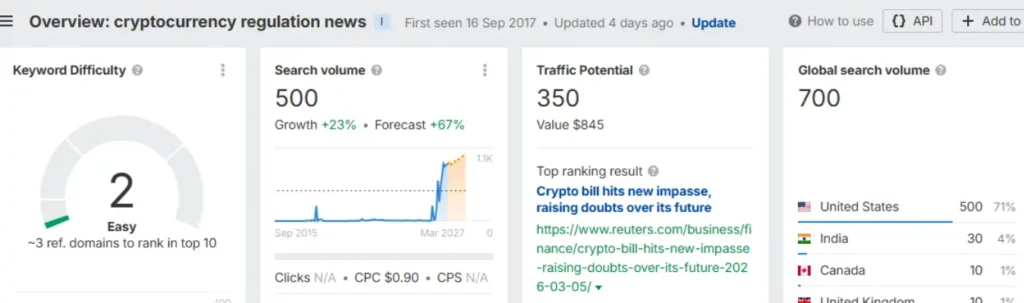
If you are just starting a crypto business and building your web presence from scratch, keyword research is the single highest-return investment you can make before writing a single word.
2. Build E-E-A-T Signals Specifically for YMYL Financial Content
E-E-A-T stands for Experience, Expertise, Authoritativeness, and Trustworthiness. For most niches, satisfying these criteria is a matter of having well-written content and a few credible backlinks. For cryptocurrency websites, the requirement is an entirely different level. Google’s Quality Raters Guidelines explicitly designate financial advice, investment information, and cryptocurrency as YMYL topics requiring the highest level of scrutiny.
For cryptocurrency websites, E-E-A-T means the following in practice. Every author writing investment-adjacent content needs a bio that includes their blockchain or financial background, a LinkedIn profile link, and where applicable, credentials such as CFA, CFP, or certified blockchain expert designations. The website itself needs a clearly authored About page, a transparent team page, and a legal disclaimer specific to the jurisdiction it serves.
Your homepage and service pages should prominently display any media coverage, partnership badges with recognized blockchain organizations, and audit certificates if you operate a DeFi protocol. If Google’s quality raters cannot verify who is behind the content and why those people are qualified to give financial guidance, the entire domain suffers in rankings. Thorough on-page SEO services that incorporate E-E-A-T signals at the content level are not optional for blockchain websites. They are existential.
3. On-Page Optimization Built Around Cryptocurrency Search Intent
On-page SEO for blockchain websites follows the same structural logic as any other niche, but the execution requires a precise understanding of how cryptocurrency audiences search. A person searching for “Ethereum staking” may want to understand what staking is, how to do it, where to stake, or what the risks are. That single keyword cluster contains at least four different intents, and effective crypto SEO strategies must map each one to a separate page with a distinct content format.
For each core page on a crypto website, map the primary intent before writing a single word. Educational intent pages — how-to guides, what-is explainers, definition posts — should lead with the answer in the first paragraph, use H2 headings that mirror common sub-questions, and include a FAQPage schema section at the end. Transactional intent pages exchange signups, wallet downloads, token purchases should prioritize trust signals, page speed, and a frictionless conversion path.
Title tags and meta descriptions for cryptocurrency content need particular care. Include the year in titles for any research or comparison content because the space moves fast and searchers reward freshness signals. Keep meta descriptions specific: “Compare Ethereum Layer 2 networks by fee, speed, and security in 2026” outperforms “Learn about Ethereum scaling” in both CTR and relevance signal. Disciplined crypto SEO strategies at the on-page level are where rankings are ultimately won or lost — technical and off-page work only amplify the signal that content quality creates.
Internal linking within cryptocurrency content should be purposeful and architecturally planned. Link from broad educational content to specific comparison pages, from comparison pages to service pages, and from service pages back to core authority pieces. Every link should serve the reader’s journey, not just mechanically pass PageRank.
4. Develop a Content Architecture Designed for Topical Authority
Google no longer rewards individual pages in isolation. It rewards websites that demonstrate comprehensive topical authority across an entire subject domain. For a cryptocurrency exchange, this means owning not just the primary commercial keywords but also the full ecosystem of educational content surrounding them. For a DeFi protocol, it means covering not just your own product but the broader landscape of decentralized finance at a depth that signals genuine expertise.
The most effective structure is a pillar and cluster model. A pillar page covers a broad topic at depth (2,500 to 4,000 words) and serves as the authority hub. Cluster pages cover specific subtopics (1,200 to 2,000 words each) and link back to the pillar. For example, a pillar on “DeFi protocols” might cluster to individual posts on liquidity pools, yield farming mechanics, DeFi insurance, impermanent loss, and smart contract security audits. Each cluster page signals to Google that the pillar is the authoritative hub for the broader topic.
Cryptocurrency content marketing is the fuel that powers this architecture. A well-executed crypto content marketing plan does not simply publish articles on trending terms, it builds systematic coverage of every subtopic in your niche at a pace that establishes the domain as the go-to resource. The brands that achieve this level of topical depth become almost impossible to displace from their ranking positions because Google’s algorithms learn to associate the entire topic cluster with their domain.
5. Technical SEO Foundations for Blockchain Websites
Technical SEO is the infrastructure that allows content to be found, crawled, and correctly interpreted by Google. For blockchain websites, several technical issues are endemic and disproportionately damaging to rankings. The most common is JavaScript rendering dependency. Many DeFi applications, NFT marketplaces, and exchange front-ends are built as single-page applications using React or Vue.js.
If critical content is rendered only after JavaScript execution, Googlebot may never see it or may index an empty shell. The solution is server-side rendering (SSR) or static site generation (SSG) for all indexable pages. Verify rendering using Google Search Console’s URL Inspection tool and comparing the rendered HTML to the raw source. Ensure your XML sitemap lists all canonicalized URLs and that the sitemap is submitted directly through Google Search Console for active crawl monitoring.
Core Web Vitals carry additional weight for YMYL sites. Research from a 2025 Ahrefs study of financial services websites showed that pages scoring in the “Good” range on all three Core Web Vitals, LCP under 2.5 seconds, CLS below 0.1, and INP under 200ms ranked on average 1.3 positions higher than pages in the “Needs Improvement” range within the same SERP.
For blockchain websites specifically: compress all token imagery using WebP or AVIF formats, use a global CDN (cryptocurrency audiences are international), implement lazy loading for price ticker widgets and chart embeds, and apply page speed optimizations to any third-party API calls.
6. Build Authority Through Cryptocurrency-Native Link Sources
Off-page SEO for blockchain websites operates within a specific ecosystem, and the rules are different from general link building. A backlink from a domain authority 80 general news site is valuable, but a backlink from CoinGecko, CoinMarketCap, Messari, The Block, or Decrypt carries disproportionate topical relevance weight for a cryptocurrency domain.
Google’s systems understand that these are the recognized authorities in blockchain journalism and cryptocurrency data. Off-page SEO built around these sources delivers trust signals that cannot be replicated by links from unrelated high-DA domains, regardless of their overall authority score.
The most sustainable link building strategies for cryptocurrency websites include submitting your token, protocol, or exchange to data aggregators (CoinGecko, CoinMarketCap, DappRadar), contributing original research or on-chain data analysis to blockchain media outlets, building relationships with cryptocurrency journalists who link to primary sources, and getting listed in exchange comparison tools and DeFi analytics platforms.
For Bitcoin SEO specifically, content on Bitcoin-focused publications like Bitcoin Magazine and Cointelegraph’s Bitcoin section carries strong topical relevance that general off-page SEO cannot replicate. Community-driven link building is also uniquely powerful in this space. Reddit communities like r/ethereum and r/defi, Discord servers for major protocols, and Telegram groups can generate both direct referral traffic and secondary link mentions when content is genuinely valuable.
7. Optimize for Featured Snippets and AI Overviews in the Cryptocurrency Space
Featured snippets are disproportionately available in the cryptocurrency space because so many searches are question-format queries: “what is proof of stake,” “how does a cryptocurrency wallet work,” “what is the difference between Bitcoin and Ethereum.” These are definitional, process-driven, and comparison queries exactly the three categories where Google most commonly awards featured snippets.
According to data compiled by SEMrush in 2025, featured snippets for financial and cryptocurrency-related queries appear in 23% of all SERPs in this category, compared to a cross-industry average of 12.3%.
Winning featured snippets in the cryptocurrency space requires formatting discipline. For definitional snippets (“what is X”), write a clean 40 to 60 word definition immediately after the H2 question heading. For process snippets (“how to X”), use a numbered list with short action-oriented steps, ideally 6 to 8 items. For comparison snippets (“X vs Y”), use an HTML table with clearly labeled columns. In each case, content needs to match the snippet format Google is already displaying for similar queries in your niche.
AI Overviews are increasingly appearing for cryptocurrency educational queries. To appear as a cited source, content needs strong E-E-A-T signals, factual accuracy cross-referenceable by other authoritative sources, and structured formatting that AI systems can excerpt cleanly. Mastering the full taxonomy of featured snippet types and optimizing for each format gives cryptocurrency content a structural advantage that is difficult for competitors to close quickly.
8. Apply Entity SEO to Establish Your Blockchain Brand as a Recognized Entity
Google no longer thinks purely in terms of keywords. Its Knowledge Graph operates at the level of entities, real-world people, organizations, products, and concepts and their relationships to each other. For blockchain projects, establishing your platform as a recognized entity in Google’s Knowledge Graph through entity SEO is one of the most durable ranking advantages available, and one that most cryptocurrency projects completely overlook.
Entity SEO establishment starts with structured consistency. Your project’s name, founding date, founders, primary function, and social media handles must be consistent across your website, CrunchBase, Wikidata, LinkedIn, CoinGecko listing, GitHub repository, and every other authoritative reference point. Inconsistency in how your entity is described across the web reduces Google’s confidence in identifying you as a distinct, verifiable entity and suppresses your Knowledge Graph eligibility.
From there, pursue secondary entity signals: mentions in blockchain media that reference your project name without necessarily linking, citations in academic or research papers covering your protocol, inclusion in DeFi ecosystem maps published by analytics platforms, and coverage in jurisdiction-specific regulatory discussions. These co-occurrence signals teach Google’s systems what your entity is, what it relates to, and how authoritative it is within the broader blockchain ecosystem.
Using Organization schema, BreadcrumbList schema, and the SameAs property on your About page to connect your website to its external entity references is the technical implementation layer of this strategy. Entity-based SEO is one of the most advanced and underused cryptocurrency SEO strategies in 2026 precisely because most blockchain marketers are still thinking in terms of individual page rankings rather than holistic entity authority.
9. Mobile Optimization and Core Web Vitals for Cryptocurrency Audiences
Cryptocurrency audiences are overwhelmingly mobile-first. A 2024 survey by Statista found that 67% of all cryptocurrency transactions globally were initiated via mobile device. Yet a significant number of blockchain websites particularly DeFi platforms and exchange front-ends still deliver substandard mobile experiences. Charts that do not resize, wallet connection modals that break on small screens, and token price tables that require horizontal scrolling are all too common in the space.
Google’s mobile-first indexing means your rankings directly reflect the quality of the mobile version. Every page on a cryptocurrency website should be tested on actual mobile devices across Android and iOS at multiple viewport sizes — not just browser simulation. Pay particular attention to interactive elements: cryptocurrency audiences interact heavily with price tickers, portfolio trackers, and conversion calculators, and these must function flawlessly on touch interfaces.
Optimize images with next-gen formats (WebP, AVIF), implement responsive images with srcset attributes, and use adaptive loading strategies that detect network quality and adjust asset delivery accordingly. Cryptocurrency users in emerging markets, where mobile data speeds are lower, represent significant untapped organic traffic. Regions like Southeast Asia, Sub-Saharan Africa, and Latin America are experiencing the fastest growth in blockchain adoption globally. A fast, reliable mobile experience is not just a ranking signal — it is a genuine competitive advantage in those markets.
10. International and Localized SEO for Cryptocurrency Platforms
Cryptocurrency is inherently global but unevenly distributed in search demand. According to Google Trends data from 2024 to 2025, the highest per-capita search interest in cryptocurrency-related terms comes from Nigeria, Vietnam, the Philippines, Turkey, and Brazil. These are markets with high adoption rates driven by currency instability, remittance needs, and underbanked populations yet most Western cryptocurrency websites do not have a single piece of content optimized for these audiences.
International SEO for cryptocurrency platforms requires far more than running existing content through a translation service. Search behavior differs meaningfully by market. Vietnamese cryptocurrency audiences search heavily for P2P trading and specific local exchange names. Nigerian audiences search for USDT wallet comparisons and stablecoin remittance options. Filipino audiences search for play-to-earn game token guidance. Each market has a distinct search intent profile that requires localized content strategy, not just localized language.
Implement hreflang tags correctly and consistently across all multi-language cryptocurrency content. Use hreflang attributes in both the HTML head and the XML sitemap to ensure Google correctly identifies the language and geographic targeting of each page. Use country-specific subdirectory URL structures (preferred over subdomains for most crypto websites).
11. NFT, DeFi, and Play-to-Earn Sub-Niche Content Strategy
One of the most significant missed opportunities in cryptocurrency SEO is the failure to build dedicated content strategies for the distinct sub-niches within blockchain. NFT collectors, DeFi yield farmers, and play-to-earn gamers have almost nothing in common from a search behavior perspective. They use different terminology, visit different platforms, and have entirely different questions. Yet most cryptocurrency websites try to serve all three with the same generic content that satisfies none of them.
NFT SEO requires building around utility-driven and marketplace-driven queries. The highest-value keywords in 2025 to 2026 cluster around NFT utility (“utility NFTs,” “NFT for event ticketing,” “NFT membership programs”), creator economics (“how to mint an NFT for free,” “NFT royalty structures”), and marketplace comparisons (“OpenSea vs Blur,” “best NFT marketplace fees 2026”). These are substantially less competitive than generic NFT terms because most content creators are still chasing the headline keywords and ignoring the long-tail opportunity sitting beneath them.
DeFi SEO demands a different content approach: protocol comparisons, risk education (“smart contract audit importance,” “rug pull detection,” “impermanent loss explained”), and detailed yield farming strategy guides. Yield farming content in particular is underserved at the depth serious DeFi users actually require — most articles covering yield farming optimization strategies stop at the surface level. Comprehensive yield farming content that covers protocol risk tiers, gas optimization, and compounding strategies ranks significantly above shallow introductory guides because it matches the sophistication of what DeFi audiences are actually searching for.
12. Schema Markup Designed for Cryptocurrency Content
Structured data is more important for cryptocurrency websites than most site owners realize. Google uses schema markup to understand content type, extract specific data points, and determine eligibility for rich results. For YMYL financial content, clear structured data reduces Google’s uncertainty about what a page is and who is responsible for it, which directly supports the trust signals that drive rankings in the cryptocurrency space.
FAQPage schema is non-negotiable for any educational content targeting question-format queries. Every explainer post, protocol overview, and comparison page should include FAQPage markup targeting the two to four most common follow-up questions on that topic. Implement all schema using JSON-LD format — Google explicitly recommends JSON-LD over Microdata and RDFa for structured data implementation, and it is significantly easier to maintain on dynamic crypto website pages without interfering with existing HTML structure.
Article schema with author markup, using Person schema with sameAs links to LinkedIn and other verified profiles, should be applied to all blog posts and educational content. For exchange and trading platform pages, consider FinancialProduct schema where applicable for your jurisdiction. Organization schema with the SameAs property linking to CoinGecko, CoinMarketCap, GitHub, and official social profiles provides the entity disambiguation signals discussed in tactic 8.
Validate all schema using Google’s Rich Results Test before deployment. Monitor the Rich Results report in Google Search Console after launch to confirm markup is being processed correctly and identify any errors preventing rich snippet display.
13. Continuous Monitoring, Analytics, and SERP Tracking for Blockchain Sites
The final tactic and arguably the one that makes all others work is rigorous, ongoing measurement. Most blockchain projects invest heavily in initial SEO setup and content production, then fail to track results with enough precision to know what is working, what is not, and why.
SERP tracking for cryptocurrency websites must account for keyword volatility. Do not evaluate rankings in isolation. Cross-reference position data with corresponding cryptocurrency market conditions at all times. If your rankings for “buy Ethereum” drop 30% during a bear market, that may be a normal function of reduced search volume and Google reweighting demand signals, not a sign that your blockchain SEO is failing. Conversely, a bull market spike that disappears when the market corrects suggests content is benefiting from transient demand rather than durable authority.
Set up custom Google Search Console segments for your most important keyword clusters. Monitor Core Web Vitals separately for mobile and desktop. Track click-through rates by page and query to identify which title tags and meta descriptions are underperforming against their ranking position. A page ranking third but achieving a 2% CTR when the position-three industry average is 7% has a content and metadata optimization opportunity that has nothing to do with technical SEO.
Use Ahrefs or SEMrush to run monthly backlink audits. Cryptocurrency websites attract spam links at a higher rate than most niches due to the speculative nature of the space. Disavow files need active management. Track domain rating, referring domain count, and anchor text distribution monthly. The monitoring and recovery frameworks used in casino SEO environments where link volatility and SERP fluctuation are equally intense apply directly to blockchain website management.
|
Tool |
Primary Use for Cryptocurrency SEO |
Specific Value in the Blockchain Space |
|---|---|---|
|
Ahrefs |
Keyword research, backlink analysis |
Cryptocurrency keyword difficulty scoring; monitor CoinGecko and CoinMarketCap referring domains |
|
SEMrush |
SERP tracking, competitor analysis |
Position tracking with volatility alerts, token keyword clustering and gap analysis |
|
Google Search Console |
Crawl health, indexation, CTR |
Rich results monitoring; mobile vs desktop Core Web Vitals splits; sitemap submission |
|
Screaming Frog |
Technical SEO audit |
Detect JS rendering issues, orphaned token pages, and duplicate meta across large exchanges |
|
PageSpeed Insights |
Core Web Vitals and page speed |
Critical for cryptocurrency exchanges running heavy JS widgets and live price data APIs |
|
Schema.org Validator |
Structured data QA |
Validate JSON-LD FAQPage, Article, Organization, and FinancialProduct markup before launch |
|
Google Trends |
Search demand cycles |
Map keyword volume fluctuations against market cycles to time content production optimally |
|
Surfer SEO / Clearscope |
Content depth optimization |
YMYL-level content scoring against top-ranking cryptocurrency pages in each target cluster |
Conclusion
The blockchain industry is uniquely positioned to benefit from serious SEO investment. Paid advertising channels remain largely unavailable to most cryptocurrency projects. Influencer marketing is volatile, expensive, and increasingly carrying regulatory risk. Social media algorithms consistently deprioritize financial content. Organic search is the one channel that compounds over time without those constraints, and it is still dramatically underinvested across the majority of the cryptocurrency ecosystem.
The 13 cryptocurrency SEO strategies outlined in this guide are not shortcuts or quick wins. They are the foundational practices that separate blockchain websites earning consistent, growing organic traffic from those watching their analytics stay flat while competitors dominate the search results they should own. The work starts with keyword strategy built around your specific sub-niche and audience, deepens through E-E-A-T content that demonstrates genuine expertise, and matures through the blockchain SEO authority signals that come from being a recognized entity in the ecosystem.
Organic authority in cryptocurrency does not happen in 30 days. It compounds in ways that become very difficult for competitors to replicate once you are meaningfully ahead. If you are ready to build a cryptocurrency SEO strategy calibrated for where Google is in 2026 and where your audience is actually searching, explore our dedicated restricted niche SEO services to see exactly how we approach sustainable blockchain website growth.