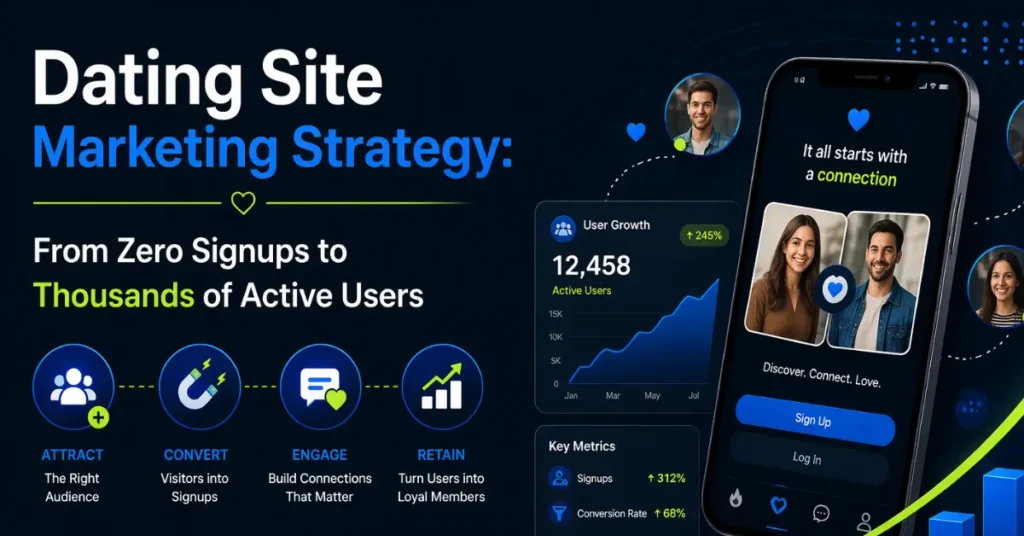
Dating Site Marketing Strategy: From Zero Signups to Thousands of Active Users
Most dating sites fail not because the product is bad but because nobody knows it exists. The founders build matching algorithms, design profiles, set up payment systems, and then realize they have no idea how to get people to actually sign up. A dating site with 200 registered users is a ghost town regardless of how good the technology behind it is. Users open it, see empty search results, and never come back.
That makes your dating site marketing strategy the single most important factor determining whether your platform survives or dies. Not your features, not your design, not your pricing model. Marketing. Specifically, the kind of marketing that produces real signups from real users who actually engage with the platform and bring other users with them through word of mouth and social proof.
The challenge with marketing a dating site is that most of the channels mainstream businesses rely on are either restricted or ineffective for this category. Google Ads limits dating advertising heavily. Facebook and Instagram restrict targeting for dating services. App stores bury new dating apps behind established competitors. And organic growth takes months to produce results without the right strategy driving it. This is the reality that every dating site operator faces, and it is the reason so many platforms with genuine potential never reach critical mass.
This guide covers every marketing channel that actually works for dating sites, including channels most operators never consider. The perspective comes from years of building organic search visibility for restricted industry businesses where standard marketing playbooks fail and specialized approaches are required to produce results.
- 01Solving the Cold Start Problem
- 02SEO: The Compounding Growth Engine
- 03CPA Networks and Affiliate Marketing
- 04Content Marketing That Attracts Users
- 05Social Media for Dating Platforms
- 06Paid Advertising Channels
- 07Influencer Partnerships
- 08Email and Notification Marketing
- 09App Store Optimization
- 10Trust, Safety and Reputation
- 11Retention: Keeping Users Active
- 12Niche Positioning Advantage
- 13Budget Allocation Framework
- 14Costly Mistakes to Avoid
- 15Final Thoughts
The Cold Start Problem Every Dating Site Faces
Every dating site faces a chicken and egg problem that most other businesses never encounter. Users will not join a platform that has no other users. But you cannot get users without having existing users to attract them. This cold start problem kills more dating startups than bad technology, bad design, or bad pricing combined. Solving it requires a specific dating site marketing strategy built around creating the illusion of activity before organic activity takes over.
The platforms that successfully break through the cold start problem do three things simultaneously. They seed the platform with enough profiles to make it feel populated even before organic signups begin. They concentrate user acquisition geographically rather than spreading thin across multiple cities. And they invest heavily in one or two marketing channels that produce fast results rather than spreading budget across every available channel and getting meaningful traction from none of them.
Geographic concentration is the strategy most dating site operators miss entirely. A dating platform with 5,000 users spread across 50 cities is useless because no single city has enough density for matches. The same 5,000 users concentrated in two or three cities creates a functional matching pool that produces real connections and generates the word of mouth growth that sustains the platform long term.
Every element of your dating site marketing should be geographically focused during the launch phase. Concentrating your dating site traffic and dating site user acquisition efforts in specific markets produces better results than spreading thin across the entire country from day one.
The density threshold: Dating platforms typically need 500 to 1,000 active users within a 25 mile radius before the matching experience produces enough quality results to retain users. Below this threshold, users search, find nothing relevant, and leave. Every marketing dollar should push toward this density target in your first market before expanding geographically.
SEO: The Only Marketing Channel That Compounds Over Time
Search engine optimization is the single most underrated channel in dating site marketing and simultaneously the highest ROI channel over a 12 month period. Every other marketing channel stops producing the moment you stop spending. SEO builds ranking positions and content authority that continue attracting new users months and years after the initial investment. For dating platforms operating in restricted advertising environments where paid channels are limited, organic search is often the primary sustainable growth engine.
The SEO strategy for dating sites targets three keyword categories that together capture users at every stage of the decision journey. Informational keywords like “best dating sites for professionals” and “how online dating works” attract people researching their options. Commercial keywords like “dating site reviews” and “compare dating platforms” attract people actively choosing a platform. And brand plus category keywords like “[your site name] review” capture people who heard about your platform and want validation before signing up.
Dating site SEO is more technical than most operators realize because dating platforms generate massive amounts of dynamic content through user profiles, and search engines need to be carefully managed to index valuable content while avoiding thin page penalties from thousands of low-quality profile pages. Proper crawl budget management, canonical tag implementation, and strategic use of noindex directives on low-value pages are technical requirements that most dating platforms get wrong. Working with an agency that specializes in dating site SEO eliminates the technical trial and error that wastes months of potential ranking progress.
Dating sites that invest in SEO during their first year typically see organic search become their largest user acquisition channel by month 8 to 12. The compounding nature of search rankings means early investment creates exponential returns compared to channels that produce linear results proportional to ongoing spend.
CPA Marketing for Dating Sites: The Acquisition Channel Most Operators Ignore
CPA marketing for dating sites is one of the most effective user acquisition channels available, yet most operators either do not know it exists or dismiss it as too complex to implement. CPA (Cost Per Action) networks connect dating platforms with affiliate marketers who drive signups in exchange for a fixed payment per completed registration or subscription. The dating vertical is one of the largest and most established categories in the CPA industry, with dedicated networks built specifically for this market.
The economics of CPA marketing dating site campaigns work differently from every other paid channel. Instead of paying for impressions or clicks with uncertain conversion rates, you pay a fixed cost per confirmed signup. This eliminates the financial risk of wasted ad spend because you only pay when you get the result you want. Typical CPA payouts for dating signups range from $2 to $15 for free registrations and $20 to $80 for paid subscription conversions depending on the geographic market and the quality of the user profile required.
The CPA networks that specialize in dating traffic include established platforms like CrakRevenue, AdCombo, TrafficPartner, and specialized dating affiliate programs. Each network has different traffic quality standards, compliance requirements, and payout structures. The most important factor when choosing CPA partners is traffic quality verification because low quality affiliates can flood your platform with bot accounts and fake profiles that destroy the user experience for legitimate members. Implement strict signup verification requirements and monitor affiliate traffic quality daily during the first month of any new CPA partnership.
| CPA Model | Typical Payout | Traffic Quality | Best For |
|---|---|---|---|
| CPL (Cost Per Lead) | $2 to $8 | Variable | Free registration growth |
| CPS (Cost Per Sale) | $20 to $80 | Higher | Premium subscription sites |
| Revenue Share | 30% to 50% | Highest | Long term partnerships |
| Hybrid | Varies | High | Established platforms scaling |
CPA fraud warning: Dating CPA campaigns are a known target for affiliate fraud. Bot registrations, incentivized signups, and recycled leads are common. Never launch a CPA campaign without server-side conversion tracking, email verification requirements, and a 30 day hold period on affiliate payouts to allow time for quality verification. The short term cost savings from skipping these protections are never worth the long term damage from polluting your user database with fake accounts.
Content Marketing That Attracts Users Who Actually Sign Up
Content marketing for dating platforms serves two functions simultaneously. It attracts potential users through search traffic and social sharing, and it builds the brand authority and trust that convinces visitors to register. Dating is an inherently personal and emotionally loaded decision, which means potential users need more reassurance than customers in most other categories before they commit to creating a profile. Content that addresses their concerns, answers their questions, and positions your platform as trustworthy converts visitors into signups at rates that paid advertising cannot match.
The content categories that work for dating site marketing include relationship advice articles, dating tips and guides, safety resources for online dating, success stories from real users, and data driven insights about dating trends in your target demographic. Each of these categories serves a different function in the user acquisition funnel. Advice content attracts top of funnel traffic from people who are not yet looking for a dating platform but who represent your future users. Safety content addresses the trust barrier that prevents signups. Success stories provide the social proof that convinces hesitant visitors to create an account.
The content strategy needs to align with SEO keyword targeting to produce compounding results. Every piece of content should target a specific search query that your potential users are searching for, and every piece should include a natural pathway to your registration page. Content that attracts traffic but does not convert visitors into signups is a vanity metric that drains budget without producing growth. Effective content marketing strategies always connect content creation directly to measurable business outcomes rather than treating content as an end in itself.
Social Media Strategy for Dating Platforms
Social media marketing for dating sites requires a fundamentally different approach than social media marketing for mainstream businesses. Dating platforms cannot simply post product promotions and expect engagement. The content that performs on social media for dating brands is content that captures the emotional experience of dating, the humor of awkward encounters, the hope of finding connection, and the relatability of shared experiences. This type of content generates organic sharing that extends reach far beyond paid distribution.
The platforms that matter most for dating site social media vary by your target demographic. Instagram and TikTok work well for dating sites targeting users under 35 because short form video content about dating experiences generates massive organic reach. Twitter (X) works for dating sites with a more outspoken or niche audience because conversation threads about dating culture attract engaged followers. Reddit works for niche dating platforms because subreddit communities around specific interests, lifestyles, and demographics are natural audiences for specialized dating services.
The mistake most dating platforms make on social media is treating it as a direct acquisition channel. Social media for dating sites is a brand awareness and trust building channel, not a direct signup channel. Users do not see a social media post and immediately register for a dating platform.
They see your content repeatedly over weeks or months, develop familiarity and trust, and eventually sign up when they are emotionally ready to start online dating. Marketing through social platforms works as a long term brand investment, not a short term conversion tool. Measuring social media success through immediate signup attribution dramatically undervalues its contribution to your overall dating site marketing strategy.
Paid Advertising Channels That Accept Dating Traffic
Paid advertising for dating sites operates in a restricted environment where the most popular ad platforms impose significant limitations. Google Ads allows dating advertising but requires certification, restricts targeting options, and prohibits certain content categories. Facebook and Instagram restrict dating ad targeting and require compliance with their dating advertising policies. TikTok Ads has emerging dating ad formats but strict content guidelines. Understanding which platforms allow what types of dating advertising and how to remain compliant is essential for any paid dating site marketing effort.
Beyond mainstream platforms, several advertising channels cater specifically to dating and relationship traffic. Programmatic display networks with adult or dating vertical specialization, native advertising platforms like Taboola and Outbrain that accept dating content, and specialized dating ad networks that connect platforms with targeted traffic sources. The cost per acquisition through these specialized channels is often lower than mainstream platforms because competition is reduced and the traffic is more qualified.
The paid advertising strategy that works for marketing a dating site combines mainstream platform campaigns for brand awareness with specialized network campaigns for direct acquisition. Google Search Ads targeting high intent dating keywords capture users actively searching for a platform. Display and native ads build brand awareness across the broader internet. And specialized dating ad networks drive cost effective signups from users already browsing dating related content. Each channel plays a different role and should be measured against different KPIs rather than applying a single cost per acquisition benchmark across all channels.
Ad restriction reality: Paid advertising restrictions for dating sites have tightened consistently over the past five years and will continue tightening. Building dependency on paid channels for your primary user acquisition creates vulnerability because policy changes can eliminate your traffic source overnight. The dating platforms with the most stable growth are those that treat paid advertising as an amplifier for organic channels rather than a standalone acquisition engine. The same restricted advertising challenge that affects dating platforms applies across the adult and restricted business advertising landscape.
Need Professional SEO for Your Dating Platform?
We build organic search visibility that produces signups without ad spend dependency.
Influencer Partnerships That Move the Needle
Influencer marketing for dating sites works when executed correctly and wastes budget spectacularly when executed poorly. The difference comes down to influencer selection and campaign structure. Dating platforms that partner with lifestyle and relationship influencers whose audiences match their target demographic see measurable signup increases. Dating platforms that partner with general entertainment influencers with massive but irrelevant audiences see engagement metrics without signup conversion.
The influencer categories that produce results for dating site marketing include relationship coaches and dating advice creators, lifestyle content creators who discuss single life and dating culture, niche community influencers whose audiences match your platform’s specialty, and micro influencers with 10,000 to 100,000 followers who have high engagement rates and genuine audience trust. Micro influencers consistently outperform macro influencers for dating platform campaigns because their recommendations carry more personal credibility and their audiences are more likely to act on suggestions for something as personal as joining a dating site.
Structure influencer campaigns around authentic platform experiences rather than scripted promotional posts. Give influencers genuine access to the platform, let them create accounts, document their real experience, and share honest reactions. Authenticity matters more for dating platforms than for almost any other product category because potential users are making an emotionally vulnerable decision and they can detect inauthentic promotion immediately. Campaigns built around genuine experience consistently outperform scripted promotions by 3 to 5 times in signup conversion rate.
Email Marketing and Push Notifications That Drive Engagement
Email marketing is the highest converting retention channel for dating sites, yet most platforms treat email as an afterthought limited to registration confirmations and password reset messages. A strategic email marketing program addresses two critical business objectives. It re-engages inactive users who registered but stopped using the platform, and it deepens engagement with active users by highlighting matches, activity, and content that keeps them coming back.
The email sequences that produce measurable results for dating platforms include welcome sequences that guide new users through profile completion and first actions during the critical first 48 hours. Match notification emails that create anticipation and pull users back to the platform when they receive new matches. Re-engagement campaigns targeting users who have not logged in for 7, 14, or 30 days with progressively more compelling reasons to return. And milestone emails celebrating user activity and reinforcing the value they are getting from the platform.
Push notifications serve a similar function for mobile dating apps, with the important distinction that notification frequency must be carefully calibrated. Too few notifications and users forget the app exists. Too many and users disable notifications or uninstall entirely. The dating platforms with the best retention rates send 2 to 4 notifications daily tied to genuine platform activity like new matches, messages, and profile visitors rather than generic promotional content designed to generate opens without delivering value.
App Store Optimization for Dating Apps
If your dating platform has a mobile app, App Store Optimization (ASO) is a marketing channel that most operators significantly underinvest in. ASO is the mobile equivalent of SEO, and for dating apps it can drive 40 to 60 percent of total organic installs when executed properly. The app stores are where millions of users actively search for dating solutions, and appearing in the top results for relevant search queries produces a steady stream of high intent installs without any advertising cost.
The ASO elements that matter most for dating apps include keyword optimization of your app title, subtitle, and description to match what users search for in the app store. Screenshot design that clearly communicates your app’s unique value proposition and shows real interface examples rather than abstract marketing graphics. Review management that maintains a rating above 4.0 because users searching for dating apps heavily weight ratings in their download decisions. And regular app updates that signal to the app store algorithms that your app is actively maintained and deserving of search visibility.
A/B testing different screenshots, descriptions, and preview videos is critical for ASO because small changes in app store presentation can produce 20 to 40 percent differences in install conversion rates. Most dating apps never test their store listing variations, which means they are leaving significant install volume on the table. If you already have a dating website and are considering whether to build an app, the technical and strategic considerations are covered in detail in our guide on how to build and launch a dating platform from scratch.
Trust, Safety, and Reputation: The Hidden Marketing Lever
Trust is the single biggest barrier to signup conversion for dating sites. Potential users worry about scam profiles, catfishing, data privacy, and personal safety. Dating platforms that actively address these concerns in their marketing convert visitors into signups at dramatically higher rates than platforms that ignore the trust question and focus only on features and matching algorithms.
The trust signals that directly improve dating site marketing conversion include visible safety policies and moderation systems, profile verification badges and identity confirmation processes, transparent privacy policies that specifically address data handling for dating platforms, user success stories and testimonials that provide social proof, and third party security certifications or audit results that validate your security claims. Displaying these trust signals prominently on your registration page and throughout your marketing materials reduces signup friction significantly.
Reputation management is equally important because potential users search for “[your platform name] reviews” and “[your platform name] scam” before registering. What they find in those search results directly determines whether they sign up or choose a competitor. Proactive dating website promotion through positive review profiles on app stores, review platforms, and social media ensures that users searching for validation find reassurance rather than unanswered complaints. Online dating marketing success depends as much on managing your reputation as it does on acquiring new users.
Retention Marketing: The Metric That Actually Determines Revenue
User acquisition gets all the attention in dating site marketing conversations, but retention is the metric that actually determines whether your platform generates revenue or burns through its budget acquiring users who leave after one session. Dating platforms have inherently challenging retention dynamics because successful users (those who find a partner) naturally leave the platform, while unsuccessful users leave out of frustration. This means your platform must constantly acquire new users while simultaneously maximizing the active lifetime of existing users.
The retention tactics that work for dating platforms include progressive profile completion incentives that give users reasons to return and invest more in their profile over the first week. Gamification elements like daily match limits, streak rewards, and profile boost incentives that create habitual usage patterns. Community features like forums, group events, and interest based groups that give users reasons to engage beyond individual matching. And personalization algorithms that improve match quality over time based on user behavior, demonstrating increasing value the longer someone uses the platform.
The retention funnel above illustrates why retention marketing matters more than acquisition marketing for dating site revenue. Most platforms lose 55% of new signups within the first 3 days because the onboarding experience fails to demonstrate value quickly enough. Improving Day 3 retention from 45% to 60% has a greater revenue impact than doubling your acquisition budget because every percentage point of improved retention compounds across the entire user base over time. Dating platform marketing success is ultimately measured not by how many users you acquire but by how many users are still active 90 days after registration.
Platforms struggling with user retention should also examine whether negative reviews and reputation issues are driving users away after signup. When new users search for your platform and find complaints from other users, it undermines the trust that brought them to register in the first place. Managing your online reputation through the strategies covered in our guide on suppressing negative search results is a retention tactic as much as it is a brand protection measure. According to Business of Apps dating market research, user trust directly correlates with retention rates across every dating platform category.
The Niche Positioning Advantage: Stop Competing With Tinder
The single biggest strategic mistake in marketing a dating site is positioning it as a general purpose dating platform competing directly with Tinder, Bumble, and Hinge. These platforms have hundreds of millions of dollars in marketing budget, tens of millions of existing users, and brand recognition that no startup can match. Competing head to head with them is not a dating site marketing strategy. It is a plan to burn budget and fail.
The dating platforms that succeed are the ones that own a specific niche their larger competitors cannot or will not serve effectively. Niche positioning reduces your addressable market but dramatically increases your conversion rate because your marketing speaks directly to a specific audience with specific needs that mainstream platforms do not address. Christian Mingle succeeded by owning faith based dating. FarmersOnly succeeded by owning rural dating. HER succeeded by owning LGBTQ+ women’s dating. Each of these platforms could not have competed with Tinder on general dating but dominated their niche because their marketing spoke directly to an underserved audience.
Niche positioning also creates a powerful SEO advantage because your content naturally targets specific long tail keywords that general dating platforms never optimize for. A dating site for musicians can rank for “dating for musicians” and “meet single musicians” with minimal competition while a general dating platform would never invest content resources in those terms. This keyword specificity means niche dating platforms can build organic search traffic faster and at lower cost than general platforms competing for high volume head terms.
Your niche does not have to be demographic. It can be lifestyle based (digital nomads, fitness enthusiasts, music lovers), preference based (serious relationships only, casual dating only), or format based (video first, voice first, activity based). The critical requirement is that your niche creates a natural content marketing angle, a natural social media voice, and a natural community that generates organic growth within the target audience.
If you are building a dating platform that serves the adult digital marketing adjacent space including adult dating and hookup platforms, the niche positioning decision carries additional strategic implications around advertising restrictions and compliance requirements that mainstream dating platforms do not face. These restrictions make organic marketing even more important for adult dating platforms than for mainstream ones.
Budget Allocation Framework: Where to Put Your Marketing Dollars
How you allocate your dating site marketing budget matters as much as how much you spend. Most dating startups spread their budget evenly across every available channel and get mediocre results from all of them instead of strong results from any of them. The dating platforms that grow fastest concentrate their budget aggressively on 2 to 3 channels during each growth phase and only diversify after establishing strong performance in their initial channels.
| Growth Phase | Primary Budget Allocation | Secondary | Tertiary |
|---|---|---|---|
| Pre-launch | Content + SEO (40%) | Social media (30%) | Influencer seeding (30%) |
| Launch (0 to 6 months) | Paid acquisition (40%) | CPA networks (30%) | SEO + content (30%) |
| Growth (6 to 18 months) | SEO (35%) | CPA + paid (35%) | Email + retention (30%) |
| Scale (18 months+) | SEO + content (40%) | Retention (30%) | Paid + CPA (30%) |
Notice how SEO allocation increases as the platform matures. This reflects the compounding nature of search rankings. Early stage platforms need faster channels like paid advertising and CPA networks to generate initial user density. But as organic rankings build, SEO becomes the dominant growth channel because it produces the lowest cost per acquisition and the results persist without ongoing spend.
This budget evolution is why establishing your dating site SEO foundation early is critical even when the results are not yet visible. According to Statista’s online dating market outlook, the platforms capturing the most organic market share are those that invested in SEO 12 to 18 months before their competitors. The rankings you build during months 1 through 6 are what produce your lowest cost dating site user acquisition during months 12 through 24.
Costly Mistakes That Kill Dating Site Growth
Marketing a dating site involves specific pitfalls that operators in other industries never encounter. These mistakes are costly not just in wasted budget but in permanently damaged brand perception and lost user trust that is nearly impossible to rebuild once broken. Understanding these failure modes before you encounter them saves months of recovery time and potentially saves your platform from the 90% startup failure rate that defines this industry.
Most dating platforms attract significantly more male users than female users in their early stages. This imbalance degrades the experience for everyone. Male users face excessive competition and low response rates. Female users feel overwhelmed and unsafe. Marketing a dating site without a specific strategy for balancing gender ratios is one of the most common causes of early platform death. Target your initial marketing specifically at the underrepresented gender in your platform to maintain a healthy ratio.
Registrations without engagement are worthless. The metrics that matter for a dating site marketing strategy are profile completion rate, Day 7 retention rate, messages sent per active user, and conversion from free to paid subscriptions. Operators who optimize for registration volume without tracking downstream engagement end up with inflated user counts and empty platforms where nobody is actually interacting. Every marketing channel should be evaluated against engagement metrics, not just signup volume.
Geographic dilution is the silent killer of dating platforms. Spending marketing budget to acquire users across 20 cities simultaneously means no single city has enough user density for the platform to function. Concentrate marketing spend on 2 to 3 target cities until user density reaches the threshold where the matching experience produces satisfying results. Only then should you expand to new geographies with dedicated local marketing campaigns for each new market.
Final Thoughts
A dating site marketing strategy that produces real growth is not a list of channels to try. It is a coordinated system where each channel serves a specific function at a specific stage of your platform’s development. CPA marketing for dating sites produces fast user acquisition during the launch phase. Content marketing and SEO build the compounding organic traffic that sustains growth long term. Social media and influencer marketing build the brand awareness and trust that converts curious visitors into registered users. And email and retention marketing ensures the users you acquire actually stay, engage, and generate revenue.
The dating platforms that succeed treat marketing as a core business function from day one rather than an afterthought they get to after building features. Your product does not sell itself in a market with thousands of alternatives. Your marketing is what determines whether anyone ever discovers your platform exists, whether they trust it enough to register, and whether they stay long enough to become paying subscribers who recommend it to friends.
Every channel covered in this guide works. But none of them work in isolation, and none of them work without the foundational decisions about niche positioning, geographic concentration, and budget allocation that determine whether your marketing spend produces growth or gets wasted on vanity metrics that look good in reports but never translate into a platform full of active, engaged, paying users.
For dating platforms serious about building sustainable organic visibility that compounds over time, starting with a professional SEO foundation is the highest leverage investment available. Specialized dating SEO services built for the unique technical and compliance challenges of dating platforms produce results that generic SEO agencies consistently fail to deliver because they do not understand the crawl budget, dynamic content, and user generated content challenges that make dating site SEO a specialized discipline. If organic search is the engine, your dating site growth strategy is the fuel that determines how fast and how far that engine takes you.