Negative SEO Attack: How to Detect, Prevent and Recover Before Your Rankings Disappear
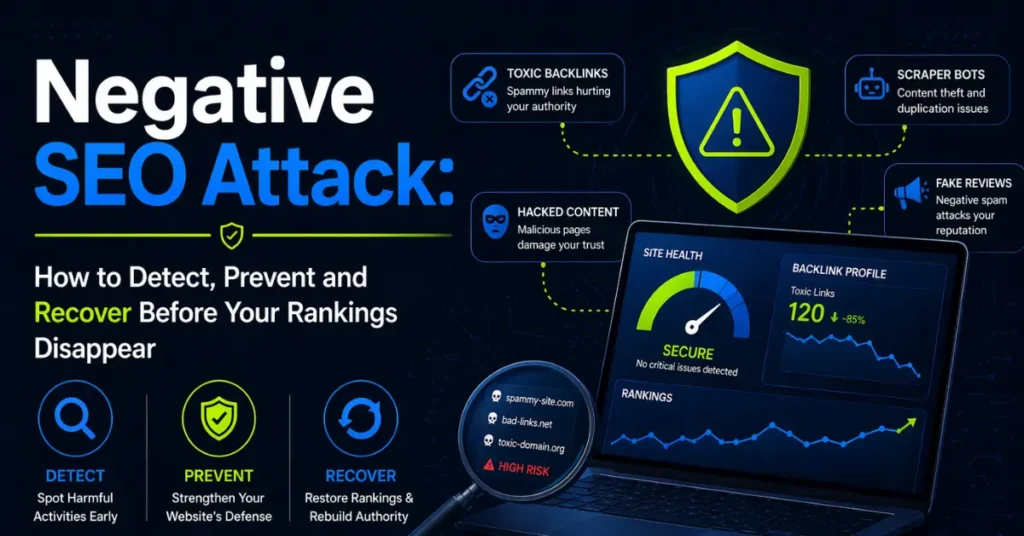
According to Search Engine Land’s research on negative SEO, over 422,000 websites were hit with some form of negative SEO in 2024 alone. A competitor buys 10,000 spammy backlinks pointing to your domain for $50 on Fiverr. Within weeks, your organic traffic drops 40 percent and you have no idea why.
You check Google Search Console, see thousands of toxic links you never built, and realize someone deliberately attacked your site to tank your rankings. That is a negative SEO attack, and if you operate in a restricted industry where organic search is your only viable traffic channel, it can destroy your business overnight.
Most businesses can absorb a temporary ranking drop because they have paid advertising, social media, and other channels to fall back on. But if you run an adult website, online casino, crypto platform, CBD store, or any business that Google Ads refuses to serve, the situation is different.
Losing your organic rankings means losing your only source of qualified traffic. This is why negative SEO attacks are disproportionately devastating for businesses in restricted industries where organic search is not just one channel among many but the entire marketing foundation.
This guide goes deeper than the surface level “monitor your backlinks” advice that dominates every other article on this topic. It covers the specific attack vectors that target restricted industry websites, the detection systems that catch attacks before they cause ranking damage, the recovery playbook that rebuilds rankings after an attack succeeds, and the prevention framework that makes your site resilient against future negative SEO attempts.
- 01What Is a Negative SEO Attack
- 027 Attack Types You Need to Know
- 03Why Restricted Industries Are Primary Targets
- 04Detection: Catching Attacks Early
- 05Monitoring Tools and Systems
- 06The Google Disavow File Playbook
- 07Recovery: Rebuilding After an Attack
- 08Prevention Framework
- 09Legal Options Against Attackers
- 10Real Attack Patterns We Have Seen
- 11Myths vs Reality
- 12Weekly Monitoring Checklist
- 13Response Speed for High-Risk Industries
- 14Final Thoughts
What Is a Negative SEO Attack and How Does It Work
A negative SEO attack is a deliberate attempt by a competitor or malicious actor to damage your website’s search engine rankings using unethical tactics. Unlike positive SEO where you build your own rankings through legitimate optimization, negative SEO tears down a competitor’s rankings by manipulating the signals Google uses to evaluate quality.
The attacker does not need access to your website. They work entirely from outside, using tactics that create the appearance that your site is engaging in spammy behavior that Google penalizes.
The core mechanism behind most negative SEO attacks exploits Google’s quality guidelines in reverse. Google penalizes websites that build artificial backlinks, publish duplicate content, or engage in manipulative practices.
An attacker creates these penalty signals pointing at your website so that Google’s algorithms associate your domain with spammy behavior even though you did nothing wrong. The result is ranking drops, manual penalties, or complete de-indexing.
Negative SEO is sometimes called adverse SEO or SEO sabotage. It exists in a legal grey area where the tactics are clearly unethical but prosecution is difficult because proving intent and attribution is challenging.
The attack itself is often cheap to execute. Buying thousands of toxic backlinks costs as little as $5 to $50 through black hat marketplaces. But the damage can cost thousands in lost revenue and months of recovery work.
7 Types of Negative SEO Attacks and Their Severity
Understanding the specific negative SEO techniques attackers use is the foundation of both detection and prevention. Each attack type targets a different Google quality signal and requires a different response. Some attacks are easy to detect and neutralize. Others are sophisticated enough to cause significant damage before the victim even realizes they are under attack.
Toxic Link Bombing: The Most Common Negative SEO Attack
Toxic link bombing is the most common negative SEO tactic because it is the cheapest and easiest to execute. An attacker purchases a package of thousands of low quality backlinks from black hat marketplaces and points them all at your domain.
These links come from link farms, hacked websites, foreign language spam pages, adult content directories, and automated blog comment networks. The goal is to make your backlink profile look like you engaged in link scheme violations.
The telltale signs of a toxic link bombing attack include a sudden spike in referring domains visible in Google Search Console or Ahrefs. Links with unnatural anchor text that does not match your brand, links from websites in foreign languages, and links from completely unrelated niches all indicate an attack.
Detecting this attack early is critical because the longer toxic links remain active, the more damage they cause to your ranking positions. Links from domains with extremely low domain ratings across dozens of different referring domains simultaneously are a strong confirmation signal.
Content Scraping and Duplicate Content Attacks
Content scraping attacks copy your original content and republish it across multiple websites. This creates dozens or hundreds of duplicate versions of your pages across the internet.
When Google encounters multiple copies of the same content, it must decide which version is the original. If scraper sites get indexed first or have stronger domain authority, Google may attribute your content to the scraper instead. This effectively steals your ranking value.
This type of negative SEO attack is particularly dangerous for content heavy websites in restricted niches because these businesses depend on informational blog content for their organic traffic. When that content gets scraped and attributed to other domains, the ranking value disappears from your site. Monitoring for content scraping requires regular searches for exact phrases from your highest performing content using quoted searches in Google to identify unauthorized copies.
Negative SEO Attack Types by Frequency
Based on Industry ReportsWhy Restricted Industry Websites Are Primary Targets for Negative SEO
Higher Attack Incentive in Restricted Markets
Businesses operating in restricted industries face a higher risk of negative SEO attacks than mainstream businesses. Competition in restricted niches is intense because fewer marketing channels are available. When organic search is the only growth channel, competitors have stronger financial incentive to sabotage each other’s rankings.
Heightened Algorithmic Scrutiny
Restricted industry websites already operate under heightened Google scrutiny. Google’s quality assessment systems apply stricter evaluation standards to YMYL categories and regulated industries. A negative SEO attack that would barely affect a mainstream site can cause severe damage to an adult or gambling website because the algorithms are already more sensitive.
Harder Recovery Process
The recovery process is harder for restricted industry sites. A mainstream business can file a reconsideration request and rebuild relatively quickly. Google treats it as a normal business that made a mistake.
A restricted industry website filing the same request faces additional scrutiny because Google is already cautious about these sites. The combination of higher attack incentive, higher algorithmic sensitivity, and harder recovery makes restricted businesses the most vulnerable targets in the entire SEO landscape.
Restricted industry warning: If your business operates in adult entertainment, online gambling, cryptocurrency, CBD, or pharmaceutical verticals, you should assume that negative SEO attacks are a matter of when, not if. Building detection and prevention systems before an attack happens is significantly cheaper than recovering after one succeeds. Proactive monitoring is a business necessity, not an optional precaution.
Detection: How to Catch a Negative SEO Attack Before It Destroys Your Rankings
Early detection is the single most important factor in minimizing damage from a negative SEO attack. An attack caught within 48 hours can often be neutralized before it causes any ranking impact. An attack that goes undetected for 30 days can cause ranking drops that take 3 to 6 months to fully recover from. The difference between these outcomes is entirely determined by whether you have active monitoring systems in place.
The detection framework for negative SEO has three layers that work together. Real time backlink monitoring catches toxic link bombing attacks as they happen. Content monitoring identifies scraping attacks before scraped copies outrank your originals. And ranking and traffic monitoring reveals the downstream effects of any attack that slips past the first two layers, giving you time to respond before clients or revenue are affected.
Backlink Profile Monitoring
Set up daily or weekly backlink monitoring using tools like Ahrefs, Semrush, or Google Search Console. The specific signals that indicate a negative SEO attack on your backlink profile include a sudden increase of more than 50 referring domains in a single week when your normal rate is 2 to 5 per month. Links with anchor text containing pharmaceutical terms, explicit content keywords, gambling terms, or foreign language text that has no connection to your business are strong indicators.
Additional red flags include links from domains with extremely low domain ratings (DR 0 to 5) across dozens or hundreds of different referring domains simultaneously. Links from domains registered within the past 30 days indicate they were created specifically for the attack. Monitoring for negative SEO backlinks requires checking these signals weekly at minimum.
Content Duplication Monitoring
Search for exact quoted phrases from your top 10 highest traffic pages on Google every two weeks. If your exact content appears on other domains without attribution, you may be experiencing a content scraping attack.
Tools like Copyscape and Siteliner automate this process by scanning the web for copies of your content and alerting you when duplicates are detected. For content-heavy businesses, this monitoring is critical because scraping can silently steal ranking value without any visible indicator on your own site.
Ranking and Traffic Anomaly Detection
Sudden ranking drops for keywords where your position has been stable for months are a strong indicator of negative SEO impact. Set up position tracking for your top 20 most valuable keywords and configure alerts that notify you when any position drops by more than 5 positions in a single day.
Similarly, configure Google Analytics alerts for traffic drops exceeding 15 percent week over week on your organic channel. These downstream indicators do not tell you which type of attack is occurring, but they do tell you that something is wrong and trigger the investigation process that identifies the specific attack vector.
Monitoring Tools and Systems for Ongoing Protection
| Tool | Monitors | Alert Speed | Cost |
|---|---|---|---|
| Google Search Console | Backlinks, manual penalties, security issues | Weekly | Free |
| Ahrefs Alerts | New/lost backlinks, brand mentions, keyword positions | Daily | Paid |
| Semrush Backlink Audit | Toxic score analysis, link quality assessment | On-demand | Paid |
| Copyscape | Content duplication across the web | On-demand | Paid per search |
| Google Alerts | Brand mentions, content republication | Daily | Free |
| Sucuri / Wordfence | Site security, malware, unauthorized changes | Real time | Free / Paid |
The minimum viable monitoring stack for negative SEO protection combines Google Search Console for backlink and penalty alerts, one paid SEO tool like Ahrefs or Semrush for deeper backlink analysis and toxic scoring, Google Alerts for brand mention monitoring, and a security plugin for real time site integrity monitoring.
This combination covers all major attack vectors at a total cost that is negligible compared to the revenue loss from an undetected attack. When you detect toxic links, the ability to quickly disavow backlinks through Google Search Console is your primary cleanup mechanism. Businesses in competitive restricted niches should also consider specialized SEO strategies built for restricted industry protection that include negative SEO monitoring as a core component rather than an afterthought.
The Google Disavow File: Your Primary Defense Against Toxic Backlinks
Google’s Disavow Tool allows you to submit a list of domains and URLs that you want Google to ignore when evaluating your backlink profile. This is your primary defense against toxic link bombing attacks.
Understanding how to use the disavow tool correctly is critical because misuse can damage your rankings just as effectively as the attack itself.
The disavow process requires careful analysis rather than blanket disavowal of everything that looks suspicious. Disavowing legitimate links accidentally removes ranking signals that took months or years to build.
The correct approach is to identify clearly toxic links based on domain quality, anchor text relevance, link neighborhood, and timing correlation with ranking drops. Disavow at the domain level for known spam domains. Disavow at the URL level only when a legitimate domain has a few spammy pages linking to you.
Disavow caution: Never disavow links without thorough analysis. Accidentally disavowing high quality backlinks is a self-inflicted negative SEO attack. If you are unsure whether a link is toxic or legitimate, err on the side of keeping it. Google’s algorithms are increasingly capable of ignoring low quality links automatically, so the disavow tool should target only clearly malicious links that Google might misattribute to your own link building activity.
Think Your Site Is Under Attack?
We audit restricted industry websites for negative SEO damage and build recovery plans that restore rankings.
Recovery Playbook: Rebuilding Rankings After a Negative SEO Attack
If a negative SEO attack has already caused ranking damage, the recovery process follows a specific sequence that must be executed in order. Skipping steps or executing them out of sequence extends the recovery timeline significantly. The full recovery from a severe negative SEO attack typically takes 2 to 6 months depending on the attack severity, the speed of detection, and how quickly you execute the response steps.
The recovery timeline depends heavily on attack severity and your domain’s existing authority. Websites with strong domain ratings and established backlink profiles typically recover faster because the toxic links represent a smaller percentage of their total link profile.
Websites with weaker authority profiles are more vulnerable because the toxic links can represent a majority of their total backlinks, making the negative signal proportionally stronger. This is another reason why continuous investment in legitimate link building for restricted niche websites creates resilience against future attacks. The stronger your legitimate backlink profile, the harder it is for toxic links to move the needle.
Prevention Framework: Making Your Site Resilient Against Future Attacks
Prevention is always cheaper than recovery. Building a negative SEO prevention framework costs a fraction of what recovery costs and eliminates the revenue loss that occurs during the ranking restoration period. The prevention framework has four components that work together to create multiple layers of protection.
Layer 1: Backlink profile strength. A strong, diverse, high quality backlink profile is your primary defense against toxic link bombing. The math is simple and the numbers tell the story clearly.
When your site has 500 legitimate referring domains and an attacker adds 200 toxic domains, the toxic percentage is 28 percent. When your site has only 50 legitimate domains, the same attack makes 80 percent of your profile toxic. Building genuine link authority continuously makes your site harder to damage.
Layer 2: Active monitoring. Daily or weekly monitoring of backlinks, content, rankings, and site security catches attacks during the early stages when neutralization is fastest and cheapest. The monitoring tools and systems described in the previous section form this layer of protection.
Layer 3: Technical security. Two-factor authentication on all CMS accounts, regular security patches, strong passwords, limited admin access, and a web application firewall prevent hacking based attacks that inject spam content or malicious redirects into your website.
Layer 4: Proactive disavow maintenance. Rather than waiting for an attack, maintain a rolling disavow file that you update monthly with any new toxic links detected during routine monitoring. This prevents toxic link accumulation and keeps your backlink profile clean continuously.
Brand Monitoring as an Early Warning System
Setting up Google Alerts for your brand name, domain name, and key staff names creates an early warning system that catches several negative SEO tactics before they cause ranking damage. Brand mention monitoring detects fake review campaigns when your business name appears on review platforms you do not monitor directly.
It also catches impersonation attempts where attackers create fake profiles or websites using your brand name to confuse both Google and potential customers. Brand monitoring reveals content scraping when your original articles are republished with attribution to other domains.
The combination of backlink monitoring, content monitoring, ranking monitoring, and brand monitoring creates a comprehensive detection system with no blind spots. Each layer catches attack types that the others miss, which is why relying on a single monitoring method leaves your site vulnerable to the attack types that method does not cover.
Building an Incident Response Plan
Having a documented incident response plan before an attack happens eliminates the panic and decision paralysis that slows recovery during an active negative SEO event. The plan should specify who is responsible for monitoring, what thresholds trigger an investigation, which tools are used for analysis, and the exact step-by-step recovery procedures for each attack type.
For restricted industry businesses, the incident response plan should also include contact information for your SEO agency, legal counsel familiar with digital crimes, and the abuse contact details for Google Search Console and major review platforms. Having these contacts pre-organized saves hours during an active attack when speed determines how much damage occurs before the response begins.
Recovery Timeline: Organic Traffic After a Negative SEO Attack
Typical PatternLegal Options: Can You Take Action Against Negative SEO Attackers
Negative SEO attacks occupy a legal grey area that makes prosecution challenging but not impossible. The legality depends on the specific tactics used, the jurisdiction, and whether you can identify the attacker. Some negative SEO tactics cross into clearly illegal territory while others remain in an ethically questionable but legally ambiguous space.
Hacking, malware injection, and unauthorized access to your website are crimes under computer fraud laws in most jurisdictions including the US Computer Fraud and Abuse Act. If you can prove a competitor hacked your site as part of a negative SEO campaign, you have both criminal and civil legal remedies available.
Content scraping that violates copyright is actionable under DMCA and equivalent international copyright laws. Fake review campaigns may violate consumer protection laws and platform terms of service. However, the most common attack type, toxic link building, is the hardest to prosecute because building links to someone else’s site is not inherently illegal. Understanding what is negative SEO from a legal perspective helps you determine which response is appropriate for each attack type.
The practical challenge with legal action is attribution. Attackers typically use anonymous services, multiple intermediaries, and offshore providers to obscure their identity. Forensic investigation can sometimes trace attacks back to competitors through patterns like timing correlation with competitive keyword battles, geographic origin matching competitor locations, or attacker infrastructure shared with competitor properties. Documenting everything from the first detection of an attack creates the evidence trail needed if legal action becomes viable.
Real Attack Patterns We Have Seen in Restricted Industries
Working with businesses across adult, casino, crypto, and CBD verticals has exposed us to negative SEO attack patterns that most generic SEO guides never mention because their authors have never worked in these niches. Restricted industry websites face attack types and frequencies that mainstream businesses rarely encounter because the competitive incentives and technical landscapes are fundamentally different.
One pattern we see repeatedly is what we call the “compliance trigger” attack. An attacker builds links from explicitly adult or gambling content domains to a competitor’s website that operates in the same restricted niche but has carefully built a compliant, SafeSearch-friendly web presence.
The goal is not just to add toxic links. It is to associate the victim’s domain with explicit content categories that trigger SafeSearch filtering or YMYL quality downgrades. This attack is particularly devastating because it exploits the exact compliance vulnerability that restricted industry websites must navigate carefully. A website that spent months building a clean, compliant adult SEO strategy can have its SafeSearch classification changed by an attacker who floods it with links from explicit content farms.
Another pattern specific to restricted niches involves fake review campaigns targeting businesses that depend on Google Business Profile for local traffic. Casino, adult entertainment, and CBD retail businesses are particularly vulnerable.
Fake negative reviews damage both ranking signals and customer conversion rates simultaneously. The attacker does not need to outrank the victim. They just need to destroy reputation signals enough to push customers toward alternative businesses.
Negative SEO: Myths vs Reality
| Myth | Reality |
|---|---|
| “Google ignores all toxic links automatically” | Google is better at detecting spam but their own documentation acknowledges that the disavow tool exists because automated detection is not perfect. Real world case studies show ranking drops from toxic link attacks even after Google’s algorithm updates. |
| “Negative SEO does not work anymore” | Over 422,000 sites were affected in 2024. The tactics have evolved but the vulnerability remains, especially for lower authority domains in competitive niches where Google’s confidence in quality signals is lower. |
| “Only small sites are vulnerable” | Large sites are harder to damage because toxic links represent a smaller percentage of their total profile. But they are not immune. High authority sites in restricted industries face targeted attacks that exploit niche-specific vulnerabilities like SafeSearch classification and YMYL quality signals. |
| “You can just ignore it and it will go away” | Some low level attacks produce no impact and resolve naturally. But assuming every attack is harmless is a gamble with your revenue. The cost of monitoring is negligible compared to the cost of a ranking collapse that could have been prevented. |
| “Filing a disavow fixes everything instantly” | Disavow files are processed during recrawling which takes 2 to 4 weeks. Full ranking recovery after a successful attack typically takes 2 to 6 months of sustained cleanup and authority rebuilding. |
Weekly Negative SEO Monitoring Checklist
Consistent weekly monitoring is the most effective negative SEO prevention strategy available. The following checklist takes approximately 30 minutes per week and covers all major attack vectors. Businesses in highly competitive restricted niches should consider daily monitoring for backlink and ranking signals because attack velocity in these verticals is typically higher than in mainstream markets.
- Check Google Search Console for new backlinks. Look for sudden spikes in referring domains. Any increase exceeding your normal monthly acquisition rate compressed into a single week warrants investigation.
- Review anchor text distribution. New links with pharmaceutical, gambling, or explicit anchor text that does not match your content indicate toxic link building targeting your domain.
- Search for scraped content. Copy a unique sentence from your top 3 blog posts, search it in quotes on Google, and verify that all results are your own pages or authorized republications.
- Check ranking positions for top 10 keywords. Sudden drops of 5 or more positions for stable keywords indicate potential algorithmic or attack-related issues that need investigation.
- Review Google Business Profile for new reviews. A cluster of negative reviews posted within a short timeframe with similar language patterns suggests a fake review attack.
- Run a site security scan. Check for unauthorized file changes, injected code, hidden pages, or malicious redirects that indicate your site has been compromised. The strategies for managing negative content in search results work together with security monitoring to protect both your rankings and your brand reputation.
- Update disavow file if needed. Add any newly identified toxic domains to your rolling disavow file and resubmit through Search Console.
Pro tip: Automate as much of this checklist as possible using Ahrefs Alerts for backlink changes, Google Alerts for brand mentions and content scraping, and rank tracking tools with automatic position drop notifications. Manual review is still necessary for interpretation, but automated detection reduces the time between attack initiation and your response from weeks to hours.
Why Your Response Speed Must Match Your Industry Risk Level
A mainstream e-commerce store that discovers a negative SEO attack can afford a measured response. They have paid advertising and social media channels to maintain revenue during recovery. A restricted industry business does not have that luxury.
When organic rankings are your only traffic source and that traffic disappears because of an attack, every day of delay in your response directly translates to lost revenue with no alternative channel to compensate.
Faster Detection for Higher Risk Businesses
Restricted industry businesses need daily rather than weekly monitoring cycles. They need pre-built response playbooks that eliminate decision-making delays during an active attack. And they need relationships with specialized SEO professionals who understand the specific vulnerabilities of adult, casino, crypto, and CBD websites.
Generic SEO agencies often misdiagnose negative SEO symptoms in restricted industry sites. They do not understand how Google’s heightened quality assessment for these verticals interacts with attack signals. They may attribute a ranking drop to an algorithm update when the actual cause is a toxic link bomb that requires immediate disavow action.
The Financial Case for Proactive Protection
If your website generates $10,000 per month in revenue from organic search and a negative SEO attack causes a 50 percent traffic drop for three months, the cost of the attack is $15,000 in lost revenue. A monthly monitoring investment of $200 to $500 eliminates that risk entirely. The math is simple for any business that depends on organic search as its primary revenue channel.
Final Thoughts
A negative SEO attack is not a theoretical risk. It is a documented threat that affects hundreds of thousands of websites annually. The businesses most vulnerable are those that depend entirely on organic search for revenue, which includes every business in a restricted industry.
The good news is that negative SEO is preventable and recoverable when you have the right systems in place. Early detection reduces attack damage by 80 percent or more. Active prevention makes your site progressively harder to damage over time.
The cost of monitoring and prevention is always lower than recovery. A 30-minute weekly routine catches attacks that would otherwise cost months of ranking rebuilding and thousands in lost revenue. The businesses that build monitoring into their SEO workflow from day one never face the devastating surprise of discovering an attack months after it started.
For businesses in restricted industries, integrating attack monitoring into your SEO strategy is a necessity. Specialized adult and restricted industry SEO include negative SEO protection as a core component because competitors in restricted markets are more likely to resort to unethical tactics when the financial stakes are this high.
Monitor weekly. Detect early. Respond fast. Build resilience through legitimate authority. The businesses that survive in competitive restricted niches are the ones that treat negative SEO defense as seriously as their offensive ranking strategies. Your rankings are worth protecting.