How to Do SEO For Restricted Industries: The Complete 2026 Guide
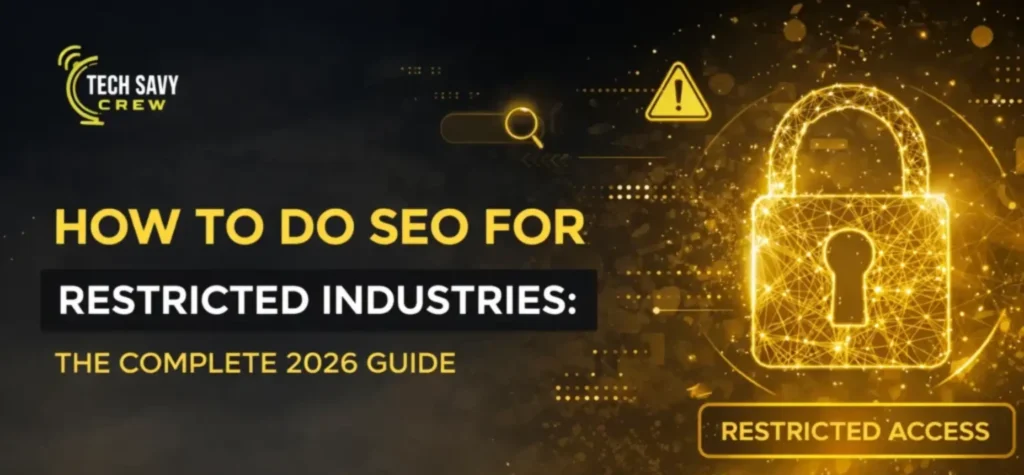
If you operate a business in an industry that Google Ads, Facebook, TikTok, and every other major advertising platform refuses to serve, you already know the pain. Your competitors in mainstream industries can launch a paid campaign in 20 minutes and start getting clicks. You cannot. Your ad account gets flagged, suspended, or permanently banned before a single impression is delivered. SEO for restricted industries is the only proven way to break through these barriers and build organic visibility that no ad platform can block, restrict, or take away from you.
This is the reality for businesses in adult entertainment, online gambling, cryptocurrency, CBD and cannabis, and pharmaceutical markets. These are the restricted industries, and for businesses operating in them, organic search engine optimisation is not just one marketing channel among many. It is the only scalable path to consistent traffic, qualified leads, and real revenue.
At Tech Savy Crew, we have spent 4.6+ years working exclusively with businesses in these banned niches. This guide covers everything we have learned about what works, what does not, and how to build a restricted niche SEO strategy that turns organic search into your primary growth engine.
What You Will Learn in This Guide:
- What Are Restricted Industries and Why Do They Exist?
- Which Ad Platforms Ban Which Industries?
- Why SEO for Restricted Industries Is Survival, Not Strategy
- How Google Evaluates Restricted Content Differently
- The Complete SEO Framework for Banned Niches
- Keyword Research When Google Hides Your Data
- Content Strategy That Complies and Converts
- Link Building When Everyone Rejects You
- Technical SEO Priorities for Restricted Sites
- AI Search Optimisation: The New Frontier for Banned Businesses
- SEO Breakdown by Restricted Industry
- 7 Mistakes That Kill Restricted Industry SEO Campaigns
- How to Choose an SEO Agency for Restricted Industries
- Frequently Asked Questions
1. What Are Restricted Industries and Why Do They Exist?
Restricted industries are business sectors where major advertising platforms, including Google, Meta, TikTok, LinkedIn, Pinterest, and Snapchat, have imposed partial or complete bans on paid promotion.
The distinction between restricted and regulated is important. Regulated industries, such as mainstream healthcare or banking, can still advertise after meeting compliance requirements. Restricted industries face categorical exclusion where no amount of compliance, licensing, or certification will grant them access to paid advertising.
The advertising platforms have made business decisions that certain types of content create unacceptable risk to their user base, brand reputation, or legal exposure. The practical reality is that if your industry falls into a restricted category, paid digital advertising is either completely unavailable or so limited that it cannot serve as a reliable growth channel.
From our experience: Across 99+ restricted industry clients in 21+ countries, we have found that businesses investing properly in organic SEO generate 3 to 5 times more qualified traffic than those attempting to work around ad platform restrictions through grey-market ad networks or cloaking techniques. The workarounds are temporary. The organic rankings are permanent.
The five core restricted industries where advertising bans are most severe:
| Industry | What Gets Banned | Business Types Affected | SEO Difficulty |
|---|---|---|---|
| Adult & Dating | All explicit content promotions across every major platform | Adult sites, escort services, OnlyFans, cam platforms, dating apps, fetish businesses, adult e-commerce | High (SafeSearch + link building challenges) |
| Casino & Gambling | Gambling promotions without jurisdiction-specific licensing | Online casinos, sportsbooks, poker rooms, iGaming affiliates, lottery platforms | Very High (YMYL + competitive keywords) |
| Crypto & Finance | Token promotions, exchange advertising, DeFi promotion | Crypto exchanges, DeFi protocols, NFT marketplaces, Web3 startups, token projects | High (policy changes monthly) |
| CBD & Cannabis | Most CBD product ads, all THC product ads | CBD retailers, dispensaries, hemp brands, edible companies, wellness brands | Medium (growing competition, FDA compliance) |
| Pharma & Healthcare | Prescription drugs, unapproved health claims, medical devices | Online pharmacies, telemedicine platforms, supplement brands, medical device companies | Medium-High (strict YMYL + E-E-A-T requirements) |
2. Which Ad Platforms Ban Which Industries?
Understanding exactly which platforms restrict which industries helps you see the full scope of the problem. These restrictions are documented in Google’s advertising policies and apply differently across each restricted vertical. Here is the current state of advertising restrictions as of 2026:
| Platform | Adult | Casino | Crypto | CBD | Pharma |
|---|---|---|---|---|---|
| Google Ads | 🚫 Banned | ⚠️ Licensed only | ⚠️ Restricted | ⚠️ Very limited | ⚠️ Certified only |
| Meta (FB/IG) | 🚫 Banned | ⚠️ Limited geos | ⚠️ Restricted | 🚫 Banned | ⚠️ Restricted |
| TikTok Ads | 🚫 Banned | 🚫 Banned | 🚫 Banned | 🚫 Banned | ⚠️ Restricted |
| LinkedIn Ads | 🚫 Banned | 🚫 Banned | ⚠️ Limited | 🚫 Banned | ⚠️ Restricted |
| Pinterest Ads | 🚫 Banned | 🚫 Banned | 🚫 Banned | 🚫 Banned | ⚠️ Restricted |
| Organic Google Search | ✅ Available | ✅ Available | ✅ Available | ✅ Available | ✅ Available |
The last row is what matters most. Organic Google search does not ban any legal industry. No matter how restricted your paid advertising options are, you always have the right to rank organically. This is the core principle behind SEO for restricted industries, and it is why organic search becomes the most valuable asset a banned business can build.
Your Industry Is Banned From Ads. We Make Google Work for You.
Choose the right restricted niche SEO strategy to build traffic, rankings, and revenue that no ad platform can take away.
Book Free Strategy Call3. Why SEO for Restricted Industries Is Survival, Not Strategy
In mainstream industries, businesses choose between paid ads, organic SEO, social media marketing, influencer partnerships, and email marketing. They allocate budgets across multiple channels and optimise for the best returns. If one channel underperforms, others compensate.
Restricted industry businesses do not have this luxury. When Google Ads, Facebook, TikTok, LinkedIn, and Pinterest have all closed their doors, the channel allocation conversation becomes extremely simple. SEO for restricted industries is not a strategic choice. It is the only reliable channel that remains available at scale.
Organic search traffic compounds over time. A blog post published today can generate traffic for 3 to 5 years without additional investment. A paid ad stops generating traffic the moment you stop paying. For businesses in banned niches where paid costs are either unavailable or prohibitively expensive, the compounding nature of organic traffic builds a growing asset that appreciates month after month.
Your competitors are underinvesting. Most restricted industry businesses focus their energy on finding workarounds, such as cloaking ad accounts, using grey-market ad networks, or rotating ad accounts to avoid detection. These tactics are unreliable and often result in permanent bans across entire business entities. Meanwhile, the businesses that commit to proper restricted niche SEO build durable market positions that shortcut-seekers will never be able to match.
Search intent in restricted markets converts at higher rates. Someone searching for an online casino, a CBD product, or an adult entertainment service typically has strong purchase intent. They are not casually browsing. They are looking to spend money, subscribe, or sign up. Organic rankings in restricted industries capture traffic that converts at rates frequently exceeding what mainstream industries achieve from their best paid campaigns.
Real data from our clients: Across our restricted industry portfolio, the average organic traffic conversion rate is 4.2%, compared to the 2.1% average for mainstream e-commerce businesses using paid traffic. Organic visitors in banned niches are pre-qualified, high-intent buyers because they had to actively search for the product or service instead of being interrupted by an ad.
4. How Google Evaluates Restricted Content Differently
Google does not apply the same evaluation standards to every website. Restricted industry websites face additional scrutiny through three specific mechanisms that fundamentally change how their content is ranked and displayed.
YMYL: Your Money or Your Life
Google classifies content as YMYL when it could significantly impact a person’s financial stability, health, safety, or overall wellbeing. This classification is outlined in Google’s Search Quality Rater Guidelines. Every restricted industry triggers YMYL classification. Casino and crypto involve financial risk. Pharma and CBD involve health decisions. Adult content involves personal safety considerations.
The practical impact is that Google holds your content to a measurably higher standard. Content quality thresholds that are acceptable for a food blog or a travel website will cause your restricted industry pages to underperform or get demoted entirely. This is the single biggest reason why generic SEO strategies fail in banned niches.
E-E-A-T: Experience, Expertise, Authoritativeness, Trustworthiness
E-E-A-T is Google’s quality assessment framework and it carries disproportionate weight for YMYL-classified content. Here is what each component means specifically for restricted industry websites:
| E-E-A-T Signal | What It Means for Restricted Industries | How to Demonstrate It |
|---|---|---|
| Experience | First-hand knowledge working in the restricted niche | Case studies, client results, industry-specific examples, years of niche experience |
| Expertise | Deep technical knowledge of the specific vertical | Author bios with niche credentials, detailed technical content, compliance knowledge |
| Authoritativeness | Recognition as a trusted source in the banned niche | Backlinks from niche publications, industry directory listings, press mentions, awards |
| Trustworthiness | Verifiable business legitimacy and transparency | Clear contact details, legal disclaimers, compliance documentation, secure website, reviews |
SafeSearch Filtering
SafeSearch is Google’s content filtering system that hides explicit results from users. This primarily affects adult SEO but also impacts gambling and other restricted content.
An incorrectly configured SafeSearch classification can make your content invisible to a significant portion of your potential audience even when you technically rank for the right keywords. Many adult sites lose enormous traffic not because of a ranking penalty but because SafeSearch is silently filtering them from results where their audience is actively searching.
5. The Complete SEO Framework for Banned Niches
After working with 99+ clients across all five restricted verticals, we have developed a structured framework that consistently delivers results. Here is an overview of how each phase builds on the previous one:
| Phase | Timeline | Focus Areas | Expected Outcome |
|---|---|---|---|
| Foundation | Month 1-2 | Technical audit, SafeSearch fix, on-page optimisation, site architecture | Clean crawling, proper indexing, baseline rankings |
| Content Build | Month 2-4 | Pillar-cluster content, E-E-A-T compliance, keyword targeting | Long-tail keyword rankings, topical authority signals |
| Authority Growth | Month 3-6 | Niche link building, digital PR, directory submissions | Domain authority increase, competitive keyword movement |
| AI & Scale | Month 4-8 | AI search optimisation, entity building, content expansion | ChatGPT/Gemini citations, traffic compounding, revenue growth |
| Domination | Month 6-12+ | Market share expansion, competitor gap closing, geo targeting | Multiple page-one rankings, sustainable organic revenue |
Each phase is non-negotiable. This is the framework that makes SEO for restricted industries work consistently, regardless of which banned niche you operate in. Skipping the Foundation phase and jumping to link building creates a house of cards. Building content without proper technical SEO means Google cannot index your best pages. The framework works as a sequence, not a menu of options.
6. Keyword Research When Google Hides Your Data
Here is something most agencies will not tell you. Google Keyword Planner, the most widely used keyword research tool, actively suppresses data for restricted industry search terms. If you type adult, gambling, or cannabis-related keywords into Keyword Planner, you will get incomplete or zero results. Google does this because Keyword Planner is part of the Google Ads ecosystem, and Google does not want to facilitate ad planning for industries it has banned from advertising.
This means keyword research for banned niches requires different tools and different methods:
Use Ahrefs or SEMrush as your primary keyword research tool. These third-party platforms pull data independently from Google and do not filter restricted industry terms. We use Ahrefs Keywords Explorer for all restricted niche keyword research because it provides the most complete volume and difficulty data for terms that Google deliberately hides.
Mine Reddit, Quora, and niche forums for keyword ideas. Your potential customers are asking questions on these platforms right now. A question like “how do I rank my adult website” on Reddit represents a real search query that your content should target. Forum mining reveals long-tail keywords that no tool can surface because they are too specific for automated keyword databases.
Analyse Google autocomplete and People Also Ask. Google does not filter these features as aggressively as Keyword Planner. Typing “CBD SEO” or “casino link building” into Google search reveals autocomplete suggestions and PAA questions that represent real user queries. These are goldmines for long-tail keyword ideas.
Run competitor keyword gap analysis. Identify what your competitors rank for that you do not. In restricted industries, these gaps tend to be much larger than in mainstream markets because most businesses are underinvesting in SEO. The opportunity is significant for anyone willing to invest properly.
7. Content Strategy That Complies and Converts
Content is where most restricted industry SEO campaigns either succeed or collapse. The challenge is threefold: your content must satisfy Google’s quality standards, comply with industry-specific regulations, and actually convert visitors into paying customers.
Build Pillar-Cluster Architecture
The most effective content structure for restricted industry websites is the pillar-cluster model. A pillar page comprehensively covers a broad topic in 3,000 to 5,000 words. Cluster pages explore specific sub-topics in 1,500 to 2,500 words each. Every cluster page links back to the pillar page and to the relevant commercial service page.
For example, a casino SEO strategy might include a pillar page on gambling SEO, supported by cluster pages covering casino link building, iGaming SEO, sportsbook SEO, responsible gambling content strategy, and multi-jurisdictional compliance. Each cluster reinforces the pillar, and the entire cluster reinforces the commercial service page.
Create Content Across the Full Buyer Journey
| Funnel Stage | Content Type | Example Keywords | Goal |
|---|---|---|---|
| Awareness (TOFU) | Educational guides, explainers | “what is restricted industry SEO”, “can you do SEO for gambling sites” | Build traffic and topical authority |
| Consideration (MOFU) | Comparisons, strategy guides | “adult SEO strategies”, “how to rank a casino website” | Establish expertise and nurture prospects |
| Decision (BOFU) | Service pages, case studies | “adult SEO agency”, “casino SEO services”, “crypto SEO company” | Convert visitors into clients |
Most restricted industry websites only create BOFU content, which means they are service pages with nothing supporting them. Without TOFU and MOFU content, Google has no basis for trusting that your site has genuine expertise. The pillar-cluster architecture naturally creates all three levels when executed properly.
Follow Compliance in Every Piece of Content
A pharmaceutical SEO strategy that includes unapproved health claims will not just hurt rankings. It could result in FDA enforcement action. A gambling content strategy missing responsible gambling messaging fails Google’s E-E-A-T evaluation because it ignores a fundamental industry standard.
A cannabis SEO campaign making direct therapeutic claims violates FTC guidelines and will get flagged by Google’s quality raters. Compliance is not a constraint on your content strategy. It is a competitive advantage.
8. Link Building When Everyone Rejects You
Link building is the single hardest component of SEO for restricted industries and specifically for banned sites. Mainstream publishers, bloggers, journalists, and directory operators refuse to link to adult, gambling, and cannabis businesses. Many link building agencies that accept restricted industry clients simply do not have the niche-specific relationships required to earn quality links.
Here are the approaches that consistently deliver results across our restricted industry client portfolio:
Niche publications and trade media. Every restricted industry has its own ecosystem of publications. Adult has XBIZ and AVN. Gambling has iGaming trade media, SBC News, and gambling-specific review networks. Cannabis has Leafly, Weedmaps, and dozens of industry publications. Crypto has CoinDesk, Decrypt, and a massive network of blockchain media. These niche publications accept contributed content, expert commentary, and sponsored features that generate relevant, high-authority backlinks.
Digital PR and data-driven content. Creating original research, surveys, data reports, or industry analyses that mainstream business media will cover. A report on online gambling industry growth published on your website can earn coverage from business publications that would never link to a casino homepage directly but will happily cite an interesting data point.
Industry directories and niche review sites. Restricted industries have their own directories. Submitting to these with complete, accurate business information generates both links and referral traffic. Quality matters more than quantity here. Five links from respected industry directories outperform fifty links from generic web directories.
Community building and forum authority. Reddit communities, niche forums, and industry-specific social platforms provide opportunities for genuine engagement that builds both authority and referral traffic over time. These are long-term plays, not quick wins, but they compound into significant authority signals.
Warning: Private Blog Networks (PBNs), paid link farms, and automated link building schemes are more dangerous in restricted industries than anywhere else. Google applies enhanced scrutiny to YMYL-classified websites, and a link penalty on a restricted industry site can take 12 to 18 months to recover from. We have seen businesses lose their entire organic traffic overnight because a previous agency used manipulative link building tactics. There are no shortcuts that survive in this space.
9. Technical SEO Priorities for Restricted Sites
Technical SEO errors that cause minor inconveniences for mainstream websites can cause catastrophic ranking losses for restricted industry sites. Here are the technical priorities specific to banned niches, ordered by impact:
SafeSearch meta tags and content classification. Adult and explicit content sites must implement correct SafeSearch rating meta tags. Incorrect or missing tags can cause explicit pages to appear in standard search results, which triggers algorithmic penalties, or cause non-explicit commercial pages to be classified as explicit, suppressing them unnecessarily.
Crawl budget management. Restricted industry sites, especially adult platforms with thousands of model profiles and casinos with thousands of game pages, frequently have crawl budget problems. When Google wastes its crawl budget on low-value dynamic pages, your important commercial pages go unindexed.
Core Web Vitals optimisation. Adult sites with heavy media content, gambling platforms with real-time data, and crypto exchanges with dynamic pricing all face unique performance challenges. These are not standard Core Web Vitals fixes. They require understanding how each industry’s specific content types affect loading, interactivity, and layout stability.
Schema markup implementation. Organization schema, FAQ schema, Product schema, and Review schema help search engines correctly interpret your content and can improve click-through rates through rich snippets. For restricted industry sites, schema that establishes business legitimacy carries extra weight because trust signals are more impactful for YMYL-classified content.
Security and compliance architecture. HTTPS is mandatory, but restricted industries need additional security measures. Gambling sites must demonstrate data protection. Adult sites need age verification systems that do not harm SEO performance. Pharma sites must show compliance with health data regulations.
Need Technical SEO Help for Your Restricted Industry Site?
Our technical audits are designed specifically for adult, casino, crypto, CBD, and pharma websites. We find issues generic agencies miss.
Get Free Technical Audit10. AI Search Optimisation: The New Frontier for Banned Businesses
In 2026, ranking on Google alone is no longer enough. AI-powered search platforms, including ChatGPT, Google AI Overviews, Gemini, and Perplexity, are fundamentally changing how people discover products and services.
For restricted industry businesses, this represents the most significant opportunity shift since the rise of organic SEO itself. Here is the critical insight: unlike Google Ads, Facebook, and TikTok, AI search platforms do not systematically ban restricted industries from appearing in their responses.
When a user asks ChatGPT “what is the best adult SEO agency” or asks Perplexity “how to rank a cannabis website,” these platforms can and do include restricted industry businesses in their answers. AI search is one of the few discovery channels that treats restricted businesses the same as mainstream businesses.
To optimise for AI search as a restricted industry business:
Build entity signals across the web. AI platforms rely on entity recognition to identify authoritative sources. Your brand name, founder name, and key personnel should appear consistently across your website, LinkedIn, industry directories, press coverage, Clutch, GoodFirms, and review platforms.
Structure content for AI consumption. Use clear heading hierarchies, definition-style paragraphs, and explicit question-answer formats. AI models parse content differently from traditional search algorithms. Content structured as “What is [concept]? [Clear definition]” performs significantly better in AI citation than content optimised purely for keyword density.
Create comprehensive, factual content. AI models prioritise content that provides clear, well-structured, factually accurate answers. Long-form guides like this one, detailed FAQ pages, and resource articles are the content types most frequently cited by ChatGPT and Perplexity.
Earn citations from multiple authoritative sources. AI models weight information more heavily when it is corroborated by multiple sources. Guest articles on industry publications, press coverage, podcast appearances, and mentions on review platforms all create citation signals that increase your probability of being selected as a source.
11. SEO Breakdown by Restricted Industry
While the framework above applies across all restricted industries, each vertical has unique characteristics that require adapted execution. Here is how the key SEO challenges and priorities differ:
| Factor | Adult | Casino | Crypto | CBD | Pharma |
|---|---|---|---|---|---|
| Biggest Challenge | SafeSearch filtering | Extreme keyword competition | Constantly changing regulations | FDA/FTC content compliance | YMYL/E-E-A-T requirements |
| Link Building Difficulty | Very Hard | Hard | Medium | Medium | Medium |
| Primary Content Type | Category pages + guides | Game guides + reviews | Educational + analysis | Product education + local | Expert-reviewed articles |
| Time to Results | 3-5 months | 5-8 months | 3-6 months | 3-5 months | 4-7 months |
| Compliance Priority | Age verification, SafeSearch | Responsible gambling, licensing | SEC/MiCA, no investment advice | FDA health claims, state laws | HIPAA, drug promotion rules |
| Our Detailed Guide | Adult SEO → | Casino SEO → | Crypto SEO → | CBD SEO → | Pharma SEO → |
12. Seven Mistakes That Kill Restricted Industry SEO Campaigns
These are not theoretical mistakes. In our 4.6+ years of delivering SEO for restricted industries, we have seen every one of them destroy campaigns for real businesses. Some we have inherited from previous agencies and had to fix. Others we have observed in competitor audits.
Mistake 1: Applying mainstream SEO strategies without adaptation. The outreach templates, content frameworks, and link building approaches designed for SaaS companies and e-commerce brands fail catastrophically when applied to restricted industries. The playbook must be rebuilt from scratch for each restricted vertical.
Mistake 2: Ignoring compliance requirements. Publishing pharmaceutical content with unapproved health claims or gambling content without responsible gaming messaging does not just hurt rankings. It creates legal liability and can result in regulatory fines, license revocation, or permanent deindexing.
Mistake 3: Using PBNs or paid link schemes. Google applies enhanced scrutiny to YMYL websites. Link manipulation tactics that might survive undetected on a mainstream website get caught faster and punished harder on restricted industry sites. Recovery from a link penalty in a banned niche takes 12 to 18 months, and many sites never fully recover.
Mistake 4: Ignoring SafeSearch configuration. Adult sites that do not properly configure SafeSearch meta tags can lose the majority of their organic visibility without any visible ranking penalty. The traffic simply disappears because SafeSearch is filtering content from users who should be seeing it.
Mistake 5: Targeting only commercial keywords. Service pages targeting “adult SEO agency” or “casino SEO services” will not rank without supporting content that establishes topical authority. Without informational content at the top and middle of the funnel, Google has no reason to trust that your site has genuine expertise.
Mistake 6: Overpromising timelines. Any agency promising page-one rankings within 30 to 60 days for competitive restricted industry keywords is either inexperienced, dishonest, or planning to use black-hat tactics that will eventually damage your site. Honest timelines for restricted industry SEO start at 3 to 5 months for initial results with significant growth between months 6 and 12.
Mistake 7: Neglecting AI search optimisation. In 2026, businesses that only optimise for traditional Google search are missing the fastest-growing discovery channel for restricted industry brands. AI search optimisation should be built into every campaign from day one, not treated as an optional add-on.
13. How to Choose an SEO Agency for Restricted Industries
Selecting the right agency for SEO for restricted industries is one of the most consequential decisions a restricted industry business will make. Here is a practical evaluation framework:
Demand vertical-specific case studies. An agency that has ranked adult websites may not understand pharmaceutical compliance. An agency experienced in casino SEO may not know SafeSearch configuration for adult content. Ask for case studies specifically from your restricted industry, not just restricted industries in general.
Test their compliance knowledge. Ask about SafeSearch for adult, YMYL for pharma, or responsible gambling for casino during the first conversation. If they cannot discuss these topics fluently without being prompted, they lack the specialised knowledge your campaign requires.
Evaluate their link building methodology. Ask specifically which niche publications, directories, and platforms they use for link acquisition in your industry. Vague statements about “high-quality backlinks” without naming specific sources indicate they have not built the niche relationships required for restricted industry link building.
Check for AI search capability. Ask how they optimise for ChatGPT, Gemini, and Perplexity. If AI search is not part of their standard offering, they are not operating at the current standard for restricted industry SEO.
Verify realistic expectations. Professional agencies set timelines of 3 to 5 months for initial ranking improvements and 6 to 12 months for significant traffic and revenue growth. Anyone promising faster results in restricted niches is likely cutting corners that will harm your site long-term.
14. Frequently Asked Questions
What is SEO for restricted industries?
SEO for restricted industries is the specialised practice of optimising websites for businesses that are banned or heavily restricted from running paid advertising on Google, Facebook, TikTok, and other major platforms. The affected industries include adult entertainment, online gambling and casinos, cryptocurrency and DeFi, CBD and cannabis, and pharmaceuticals. Because these businesses cannot rely on paid advertising for customer acquisition, organic search engine optimisation becomes the primary and often only scalable channel for driving traffic, leads, and revenue.
Is it legal to do SEO for adult, gambling, or cannabis businesses?
Yes. SEO activities for any legal business are entirely permissible. Google’s advertising restrictions apply specifically to paid promotions on the Google Ads platform, not to organic search results. As long as your business operates legally within your jurisdiction and your website content complies with both applicable laws and Google’s webmaster guidelines, you have every right to optimise your website for organic search visibility. SEO is not advertising. It is optimisation of your own property.
How is restricted industry SEO different from regular SEO?
Restricted industry SEO differs from mainstream SEO in five critical ways. First, link building is significantly harder because mainstream publications refuse to link to content in banned niches. Second, content must comply with industry-specific regulations that go far beyond standard SEO best practices. Third, Google’s YMYL classification means higher quality standards are applied to every page. Fourth, SafeSearch filtering can suppress visibility in ways that do not affect mainstream websites. Fifth, the competitive dynamics are different because most competitors in restricted industries are underinvesting in organic SEO, which creates larger opportunities for businesses that invest properly.
How long does it take to see results?
Most businesses in restricted industries see measurable ranking improvements within 60 to 90 days, with significant traffic and revenue growth between months 4 and 8. Restricted industry SEO typically progresses more slowly than mainstream SEO due to limited link building opportunities and stricter content requirements. However, the compounding returns over 12 to 24 months significantly exceed what any paid campaign could deliver, even in industries where paid advertising is available.
Can AI search platforms help restricted businesses get discovered?
Yes. Unlike advertising platforms, AI-powered search engines such as ChatGPT, Gemini, and Perplexity do not systematically exclude restricted industries from their responses. When users ask these platforms questions about products or services in restricted markets, businesses can appear in the answers. This makes AI search one of the most valuable emerging discovery channels for restricted industry businesses, and optimising for AI citation should be a standard component of every restricted niche SEO campaign.
How much does restricted industry SEO cost?
SEO for restricted industries typically costs 20 to 40 percent more than mainstream SEO due to the specialised expertise required, the difficulty of link building in banned niches, and the additional compliance requirements for content creation. However, the return on investment tends to be higher because organic search is often the only scalable acquisition channel available to these businesses. The revenue generated per dollar invested in restricted industry SEO frequently exceeds what mainstream businesses achieve from their combined paid and organic marketing efforts.
Ready to Rank Your Restricted Industry Business?
We have helped 99+ businesses across adult, casino, crypto, CBD, and pharma industries generate over $6.6 million in revenue through organic search. Book a free strategy call with our founder to discuss how we can build the same growth engine for your business.
Book Free Strategy Call